




Finding the Right Way to Experience Vienna
Vienna rewards almost every approach — walking its baroque streets, sitting for hours in its coffeehouses, standing in the gallery of the State Opera, cycling along the Danube, or eating your way through a Beisl menu you can’t fully translate. It’s a city where the cultural offering is so deep and so varied that the main risk isn’t missing something important, it’s trying to do everything and enjoying nothing properly.
This page brings together every Vienna tour and experience we recommend, organised by category so you can start with what matters most to you. Below, we’ll walk you through the main tour types, help you understand what each offers, and point you toward the right experience for the time you have and the things you care about.
Palaces and Imperial History
The Habsburgs ruled from Vienna for over six centuries, and the city they built reflects that — monumental, layered, and inescapable. Two palaces anchor the imperial experience, and understanding what each offers helps you plan your time.
Schönbrunn Palace is Vienna’s most visited attraction and the more visually spectacular of the two — a vast yellow-ochre summer residence with formal gardens stretching to a hilltop viewpoint. The palace interior offers two tour circuits: the shorter Imperial Tour covering Franz Joseph and Sisi’s apartments, and the longer Grand Tour adding Maria Theresa’s magnificent state rooms. The gardens, Gloriette terrace, maze, and zoo extend the visit into a full half-day. For most first-time visitors, Schönbrunn is the single must-see.
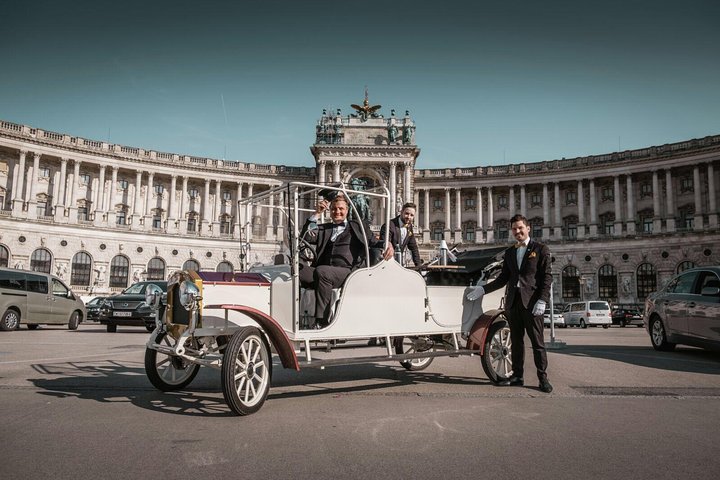
The Hofburg is the city-centre counterpart — the political palace where the empire was actually run. It’s a complex rather than a single building, housing the Imperial Apartments, the Sisi Museum, the Silver Collection, the Spanish Riding School, and the Austrian National Library’s extraordinary State Hall. The Hofburg is less immediately photogenic than Schönbrunn but more historically substantial, and a guided tour here unlocks stories that the rooms alone don’t tell.
Visiting both gives you the complete Habsburg picture — the political machinery at the Hofburg and the domestic life at Schönbrunn. A morning at one and an afternoon at the other makes a satisfying full day.
Walking Tours and City Exploration
Walking is how Vienna reveals its details — the medieval courtyards hidden behind baroque facades, the plaques marking where composers lived and worked, the Durchhäuser passageways that cut through buildings between streets. The Innere Stadt is compact enough to walk comfortably and dense enough to fill days of exploration.
General city walking tours cover the essential Innere Stadt circuit in 2–3 hours — Stephansdom, the Hofburg exterior, the Graben, Kohlmarkt, and the hidden lanes in between. These are the best starting point for first-time visitors, providing the orientation and historical framework that makes everything else click.
Themed walking tours go deeper on specific subjects — Habsburg history, Vienna’s extraordinary musical heritage (Mozart, Beethoven, Schubert, Strauss, Mahler), art and architecture from Gothic through Secession to contemporary, Jewish heritage, or the Cold War and Third Man history. These are where Vienna’s intellectual depth becomes accessible, and they’re best scheduled after an initial overview tour has given you the general context.
Private walking tours let you shape the route, the emphasis, and the pace around your group’s interests. For visitors with specific passions — music, art, architecture, food — a private guide who specialises in that subject transforms a city walk into something closer to a personal masterclass.
Music, Opera, and Performance
Vienna’s identity as the world capital of classical music isn’t historical nostalgia — it’s a living reality. On any given evening, dozens of performances run across the city, from the world’s finest orchestras to intimate palace chamber concerts.
The Vienna State Opera offers two experiences: guided tours of the building (available most days, roughly 40 minutes, covering the auditorium, backstage, and grand staircase) and attending a performance during the season (September–June). The Opera stages a different work almost every night, and standing room tickets make world-class opera accessible for a few euros.
Strauss and waltz shows are Vienna’s signature visitor-oriented performance — orchestras in period costume, professional dancers, and Strauss family music performed in palace halls and historic venues. The best combine genuine musical quality with stunning settings. These run nightly and are the most accessible entry point for visitors who don’t normally attend classical concerts.
Classical concerts beyond the Strauss shows span the full range — the Vienna Philharmonic at the Musikverein (the Golden Hall, arguably the world’s finest concert venue), the Konzerthaus, church concerts at the Karlskirche, and chamber music in palace salons. The choice depends on your musical taste, budget, and how much formality you want.
Food, Coffee, and Wine
Vienna’s culinary culture is one of its defining features — a heritage cuisine shaped by centuries of empire, a coffeehouse tradition recognised by UNESCO, and urban vineyards that produce wine within the city limits.
Food tours introduce the full spectrum — Wiener Schnitzel at a proper Beisl, Käsekrainer from a Würstelstand, market produce at the Naschmarkt, and pastries beyond the ubiquitous Sachertorte. These are the tours that set you up to eat well for the rest of your trip, with specific recommendations and the confidence to order beyond the English menu.
Coffee and cake tours focus on the coffeehouse tradition specifically — visiting historic cafes, understanding the difference between a Melange and an Einspänner, and tasting pastries from Konditoreien that most visitors never find. The coffeehouses are cultural institutions, not just places to drink, and a guided tour reveals why.
Wine tours take you to the Heurigen — the wine taverns in Vienna’s vineyard districts where locals spend warm evenings drinking young Grüner Veltliner and eating cold buffet food in garden courtyards. Vienna’s urban winemaking tradition is unique among world capitals, and the Heuriger experience is one of the most authentically local things you can do in the city.
Day Trips From Vienna
Vienna’s position makes it a natural base for exploring Austria and the surrounding region. Three day trips stand out, each offering something the city itself can’t.
The Wachau Valley is the most accessible (roughly 90 minutes by road or train) and arguably the most rewarding single day trip. The UNESCO-listed Danube valley combines Melk Abbey (one of Europe’s finest baroque buildings), a river cruise through terraced vineyards and medieval villages, the picture-perfect town of Dürnstein, and wine tastings at the source of Austria’s best Grüner Veltliner and Riesling. It’s the day trip that gives you the most variety for your time.
Salzburg sits roughly 2.5–3 hours west — Mozart’s birthplace, a UNESCO World Heritage baroque old town, the Hohensalzburg fortress, and the filming locations of The Sound of Music. It’s a longer day (11–13 hours) but delivers a completely different Austria — alpine, compact, and musically rich.
Hallstatt is the most distant day trip (3.5–4 hours each way) and the most visually dramatic — a tiny lakeside village wedged between the Alps and a mirror-still lake. It’s a full day committed primarily to travel, but for visitors who prioritise landscape over urban culture, Hallstatt is extraordinary.
Active and Alternative Tours
Not every Vienna experience happens in a palace or a concert hall. The city’s infrastructure supports several active and vehicle-based tour formats that show the city from a different perspective.
Bike tours take advantage of Vienna’s flat terrain and extensive cycle path network, covering three to four times the distance of a walking tour — the Ringstrasse, Stadtpark, Danube Canal, Prater, and outlying neighbourhoods — in 2.5–4 hours. These are the best orientation format for active visitors and an excellent complement to indoor-focused palace and museum days.
Evening tours capture Vienna’s transformation after dark — illuminated Ringstrasse monuments, the Heuriger tradition in the vineyard villages, Danube river cruises with dinner, and the performing arts scene that peaks after 7:00 PM. Vienna at night is arguably more atmospheric than Vienna by day, and an evening tour is how you access that version of the city.
Planning Your Vienna Itinerary: A Quick Framework
One day in Vienna: A city walking tour in the morning for orientation, Schönbrunn Palace in the afternoon, and a Strauss or waltz concert in the evening. This covers the essentials and gives you the imperial, musical, and architectural highlights.
Two days: Add the Hofburg (interior tour plus Spanish Riding School if the schedule aligns), a food or coffee and cake tour, and a State Opera performance or church concert in the evening. Day two fills in the cultural depth that day one framed.
Three days: Add a day trip — the Wachau Valley for wine and river scenery, Salzburg for musical heritage and alpine charm, or Hallstatt for dramatic landscapes. Alternatively, spend the third day on a themed walking tour matching your interests (music, art, Jewish history) and a Heuriger wine evening.
Four or more days: You have room for a bike tour, multiple themed walks, a dedicated wine tour, deeper museum exploration (the Kunsthistorisches Museum and the Belvedere both deserve half-day visits), and the luxury of returning to coffeehouses and neighbourhoods you discovered earlier in the trip. Vienna improves the longer you stay — it’s a city that rewards repetition and depth over rushing.
Browse the categories below to find the tours and experiences that match your interests, your time, and your priorities. Each listing includes full details on duration, format, and what’s included, so you can build a Vienna itinerary that fits you rather than following someone else’s template.