
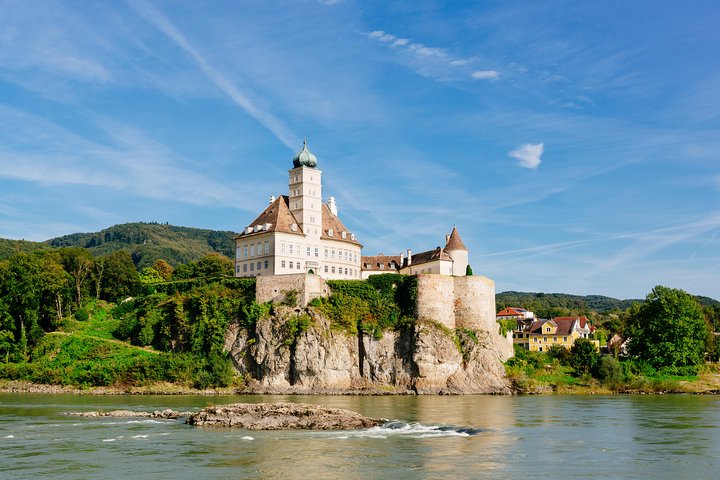

Austria’s Most Beautiful River Valley
The Wachau is a 36-kilometre stretch of the Danube Valley between Melk and Krems, roughly 80 kilometres west of Vienna. It’s a UNESCO World Heritage landscape of terraced vineyards climbing steep hillsides, medieval towns pressed between river and cliff, ruined castles above every bend, and apricot orchards that turn the valley pink and white in spring. It’s also one of Austria’s premier wine regions, producing Grüner Veltliner and Riesling of a quality that rivals the best white wines in Europe.
For visitors based in Vienna, the Wachau is the most rewarding day trip that combines landscape, wine, food, history, and river scenery in a single outing. The valley is more accessible than Hallstatt (roughly 1.5 hours by road or train versus 3.5+), more varied in what it offers, and less overwhelmed by mass tourism — though it’s popular enough that the major stops get busy in peak season.
What a Wachau Day Trip Includes
Most organised Wachau tours from Vienna run as full-day excursions, departing in the morning and returning by early evening. The standard format includes transport, a guide, and stops at the valley’s key highlights — though what’s emphasised varies significantly between operators.
Melk Abbey is the most common starting point. The Benedictine monastery sits on a rocky bluff above the Danube and is one of the finest baroque buildings in Europe — the church interior, the library (with ceiling frescoes by Paul Troger), and the terrace overlooking the river are genuinely spectacular. Most tours include a guided visit of about an hour. Melk Abbey alone justifies the day trip for visitors interested in architecture or religious history.
The Danube river section between Melk and Krems is the scenic heart of the Wachau. Some tours include a river cruise through this stretch (typically 1.5–2 hours by boat downstream), which gives you the valley from the water — passing vineyards, castle ruins, and riverside villages at a slow, contemplative pace. Other tours drive the route with stops at viewpoints and villages. The river cruise is the more atmospheric option and the one most visitors remember; the drive is faster and leaves more time for other activities.
Dürnstein is the valley’s most picturesque town — a cluster of pastel-coloured houses beneath the ruins of Kuenringerburg castle, where Richard the Lionheart was legendarily imprisoned after the Third Crusade in 1192. The blue-and-white baroque church tower is the Wachau’s most photographed landmark. The town is small enough to walk in 30 minutes and charming enough to want longer. The surrounding vineyards produce some of Austria’s finest Riesling.
Krems and Stein sit at the Wachau’s eastern end — twin towns connected along the river that serve as the valley’s commercial and cultural centre. Krems has a well-preserved old town, a vibrant wine bar scene, and the Kunsthalle Krems (a contemporary art museum). Stein is quieter and more atmospheric, with medieval streets that feel untouched. Together they’re less tourist-oriented than Dürnstein and offer a more local-feeling experience.
Wine tastings feature in most Wachau tours, either at a winery, at a Heuriger in one of the valley’s villages, or at a cellar door. The Wachau’s wine classification system — Steinfeder (lightest), Federspiel (mid-weight), and Smaragd (the richest, most concentrated wines) — is unique to the region and worth understanding before you taste. The best tours visit a winery where the winemaker explains the terroir and the classification while you taste across the categories.
Apricot season (mid-June to mid-July) adds a bonus layer to a Wachau visit. The valley is Austria’s apricot capital, and during harvest season the fruit appears everywhere — fresh at farm stands, in Marillenknoedel (apricot dumplings), in Marillenschnaps (apricot brandy), in jams, and in cakes at every bakery. Some tours specifically time their Wachau visits to coincide with the harvest.
Choosing the Right Tour Format
Large group bus tours are the most affordable option and typically include Melk Abbey, a river cruise or scenic drive, and a stop in Dürnstein. Group sizes range from 20 to 50 depending on the operator. The format is efficient but rigid — you move on the group’s schedule, and time at each stop is fixed regardless of your interest level. For visitors who want a straightforward Wachau overview without managing logistics, these deliver adequate value.
Small group tours (8–15 people) offer a better pace with more flexibility at each stop, a more personal guide dynamic, and often higher-quality wine tasting experiences. The guide can adjust timing based on the group’s interests — lingering longer in Dürnstein if the group is engaged, or extending a winery visit if the conversation with the winemaker is flowing. The price premium over large group tours is modest relative to the improved experience.
Private tours give you complete control over the itinerary. Want to skip Melk Abbey and spend the day entirely on wine? Want to visit a specific winery you’ve read about? Want to combine the Wachau with a stop in the Kremstal or Kamptal wine regions? A private guide accommodates all of this. For wine enthusiasts, food lovers, and anyone with specific interests, a private tour is the format that delivers the most.
Self-guided by train and boat is a viable independent option. The train from Vienna to Melk takes about an hour, the river cruise from Melk to Krems runs several times daily in season, and the train from Krems back to Vienna takes about an hour. This gives you the key Wachau experiences — Melk Abbey, the river cruise, and time in Dürnstein or Krems — without a guide but with complete flexibility. The trade-off is no wine tasting logistics (you’d need to arrange these independently) and no guided commentary during the river cruise.
The Wine: What Makes the Wachau Special
The Wachau’s wines are distinctive because of the valley’s specific geography. The Danube runs east-west through this section, creating south-facing slopes that receive maximum sunlight. The soils are primarily gneiss and granite (on the steeper upper slopes) and loess (on the lower terraces), and the vineyards are dramatically steep — many can only be worked by hand. The combination of sun exposure, rocky soil, altitude variation, and the Danube’s temperature-moderating influence produces white wines with an intensity and mineral complexity that flat-land vineyards can’t replicate.
Grüner Veltliner from the Wachau is richer, more concentrated, and more age-worthy than the everyday versions served in Viennese Heurigen. At the Smaragd level, these are serious wines that compete with the best white Burgundy in complexity if not in style.
Riesling in the Wachau produces dry, mineral wines with a precision and longevity that puts them alongside the finest from Alsace and Germany’s Mosel. The best Wachau Rieslings come from the steep terraced vineyards above Dürnstein, Spitz, and Weissenkirchen.
The Vinea Wachau classification (Steinfeder, Federspiel, Smaragd) is based on the wine’s ripeness level at harvest rather than sweetness — all three categories are dry. Steinfeder wines are the lightest and most refreshing. Federspiel wines have more body and structure. Smaragd wines are the most powerful and concentrated, named after the green lizards that sun themselves on the vineyard walls. Tasting across all three categories at a single winery is the best way to understand what the classification means in practice.
Seasonal Considerations
Spring (April–May) brings blossom season — the apricot trees flower first, followed by the vineyards leafing out. The valley is green, relatively quiet, and the walking conditions are ideal. The river cruise season typically starts in April.
Summer (June–August) is peak season. The vineyards are in full leaf, all attractions and river services operate at full capacity, and the apricot harvest (mid-June to mid-July) adds seasonal culinary interest. Dürnstein and Melk are at their busiest. Heat can be a factor in July and August, particularly during Melk Abbey visits.
Autumn (September–October) is harvest season and arguably the most rewarding time to visit for wine lovers. The vineyards turn gold, the Sturm (partially fermented new wine) appears at Heurigen and wine bars, and the valley has an atmospheric ripeness. Winery visits during harvest offer a behind-the-scenes look at production that’s not available the rest of the year.
Winter (November–March) sees most river cruises suspended, reduced opening hours at Melk Abbey, and a quieter valley. The Wachau in winter is peaceful and beautiful in a stark, monochrome way, but the tourist infrastructure is significantly scaled back. Some tours don’t operate during this period.
Practical Tips
Don’t try to do everything. A Wachau day trip from Vienna gives you time for Melk Abbey, a river cruise or scenic drive, and one or two village stops with a wine tasting. Attempting to add the Göttweig Abbey, multiple wineries, a bike ride along the Danube, and an extended Krems visit will rush everything. Focus on what interests you most and leave the rest for a return trip.
Book river cruise segments in advance during peak season. The DDSG and Brandner cruise lines operate the Melk-to-Krems route, and the more atmospheric smaller boats can fill up on summer weekends. Organised tours handle this for you; independent visitors should book ahead.
Bring a layer for the river. Even on warm days, the river breeze on the cruise deck is cool. A jacket or windbreaker makes the 90-minute cruise comfortable rather than chilly.
The cycle path is an alternative to the cruise. The Danube Cycle Path (Donauradweg) runs through the Wachau and is one of Europe’s finest river cycling routes — flat, well-surfaced, and scenically spectacular. Bike rental is available in Melk and Krems. Cycling from Melk to Krems takes 2–3 hours at a comfortable pace and lets you stop wherever you want — vineyards, village cafes, riverside picnic spots. This is an excellent option for active travellers who’d rather ride than cruise.
Buy apricot products directly from farm stands. During harvest season, roadside stands in the Wachau sell fresh apricots, jams, schnapps, and dried fruit at far better quality and prices than tourist shops. The Marillenschnaps (apricot brandy) makes a distinctive souvenir.
Taste wine at the source. The Wachau’s best wines are available at the wineries and in local restaurants at prices significantly below what you’d pay for the same bottles in Vienna or internationally. If you find wines you like, buy a bottle or two — many wineries will ship internationally.
Frequently Asked Questions
How far is the Wachau from Vienna?
Melk is roughly 90 kilometres west of Vienna — about 1 hour 15 minutes by car or 1 hour by train. Krems is closer at about 80 kilometres, roughly 1 hour by train. The valley is significantly more accessible than Hallstatt or Salzburg, making it the most time-efficient day trip from Vienna for a full landscape and cultural experience.
Can I do a Wachau tour and a Hallstatt tour on the same trip?
They’re different directions from Vienna (Wachau to the west, Hallstatt to the southeast) and each is a full-day commitment, so they need to be on separate days. Both are worthwhile but serve different purposes — the Wachau combines wine, history, and river scenery, while Hallstatt is primarily about the village and lake landscape.
Is the river cruise essential or can I skip it?
The river cruise is the most atmospheric component of a Wachau visit — seeing the valley unfold from the water at a slow pace is a unique perspective. That said, if your time is limited and wine is your priority, skipping the cruise and driving the valley to spend more time at wineries is a valid choice. The cruise is also weather-dependent for enjoyment — a grey, rainy day diminishes the scenic experience.
Should I visit the Wachau independently or with a tour?
Independent visits are straightforward — the train connections are good, the river cruises are easy to book, and the villages are walkable. A guided tour adds wine expertise (a guide who knows which wineries to visit and can explain the classification system), historical commentary (particularly at Melk Abbey), and logistics management. For wine-focused visits, a guide with wine knowledge is the stronger choice. For a scenic day out with a river cruise and a village walk, independent travel works perfectly well.
What should I eat in the Wachau?
The valley’s specialties include Wachauer Marillenknödel (apricot dumplings — available everywhere in season), freshwater fish from the Danube (Wels catfish and Zander are local favourites), Grüner Veltliner-braised pork, and the bakery products of the small-town Konditoreien. Dürnstein and Krems both have excellent restaurants ranging from casual wine taverns to fine dining that showcases the valley’s produce alongside its wines.