




The Only Capital City With Its Own Vineyards
Vienna is unique among the world’s major capitals — it has over 600 hectares of commercial vineyards within the city limits, producing roughly 2.4 million litres of wine annually. These aren’t decorative vines on a palace terrace. They’re working vineyards on the hillsides of the city’s outer districts — Döbling, Floridsdorf, Liesing, Mauer — where Grüner Veltliner, Riesling, and Gemischter Satz (a traditional Viennese field blend of multiple grape varieties grown and harvested together) are cultivated, harvested, and vinified by urban winemakers.
The result is a wine culture that’s genuinely embedded in the city rather than something you have to drive to the countryside to experience. The Heuriger — Vienna’s traditional wine taverns — are a 15-minute tram ride from the city centre, and the vineyards themselves form the green fringe of the city, visible from hilltop viewpoints with the Stephansdom spire in the distance. A Vienna wine tour takes you into this world, connecting the city’s urban sophistication with its improbably rural winemaking tradition.
The Heuriger Tradition
The Heuriger (plural: Heurigen) is the institution at the centre of Viennese wine culture, and understanding it before you visit makes the experience far richer.
A Heuriger is a wine tavern licensed to serve its own wine — the word literally means “this year’s,” referring to the young wine from the most recent vintage. The tradition dates to a 1784 decree by Emperor Joseph II allowing winemakers to sell their own wine and food directly to the public on their premises. When a Heuriger is open and serving, a pine branch (Buschen) is hung above the entrance — a tradition called “Ausg’steckt.”
The atmosphere at a genuine Heuriger is distinctly different from a city restaurant. Most have courtyards or gardens with long communal tables under old trees, a self-service cold buffet (Buffet) offering bread, spreads, cold meats, cheese, pickles, and sometimes warm dishes, and a counter where you order wine by the glass or the Viertel (quarter litre). The ambiance is casual, convivial, and local — families, couples, groups of friends, and elderly regulars share the garden, and on warm evenings Schrammelmusik (traditional Viennese folk music) may be played live.
The wine at Heurigen focuses on lighter, fresh styles — Grüner Veltliner (the Austrian signature white, peppery and crisp), Gemischter Satz (the traditional Viennese field blend, complex and aromatic), young Riesling, and occasionally a light red or rosé. The quality ranges from simple and pleasant at commercial Heurigen to genuinely excellent at the smaller, winemaker-operated establishments. A wine tour guide will know the difference and take you to the latter.
The distinction between a genuine Heuriger and a tourist-oriented one matters enormously. The wine villages of Grinzing and Neustift am Walde are the most famous and the most visited, but several establishments in these areas have evolved into tourist operations — overpriced, packaged, and performing a version of Heuriger culture rather than living it. The authentic Heurigen, often in Stammersdorf, Strebersdorf, Nussdorf, or the back streets of Grinzing, serve their own wine, prepare their own food, and fill with locals who’ve been coming for years. A good wine tour guide takes you to the real ones.
Types of Wine Tours
Heuriger evening tours are the most popular format. A guide collects your group from the city centre and takes you to one or two Heurigen in the wine villages, usually by public transport or minivan. You’ll spend 2–3 hours eating, drinking, and learning about the wine, the winemaking tradition, and the cultural role the Heuriger plays in Viennese life. These tours typically run in the late afternoon or evening and align with the natural rhythm of Heuriger culture — this is where Viennese go after work and on weekend evenings.
Vineyard walking tours take you into the vineyards themselves, usually on the slopes above Nussdorf, Kahlenberg, or Neustift am Walde. You’ll walk through the vines with a guide who explains the grape varieties, the terroir, and the unusual reality of urban viticulture — how winemaking coexists with public transport, apartment blocks, and the Vienna Woods. These tours usually end at a Heuriger or winery for a tasting, and the views from the hillside vineyards across the city below are a highlight in their own right.
Wine tasting experiences are more structured, seated tasting sessions — sometimes at a winery, sometimes at a city wine bar — where a sommelier or winemaker guides you through a flight of Austrian wines with detailed commentary on each. These focus on the wine itself rather than the cultural setting, and they cover a broader range than you’d encounter at a single Heuriger — perhaps Grüner Veltliner from Vienna alongside wines from the Wachau, Burgenland, and Styria. If your interest is specifically in understanding Austrian wine rather than experiencing Heuriger culture, a tasting session is the more educational format.
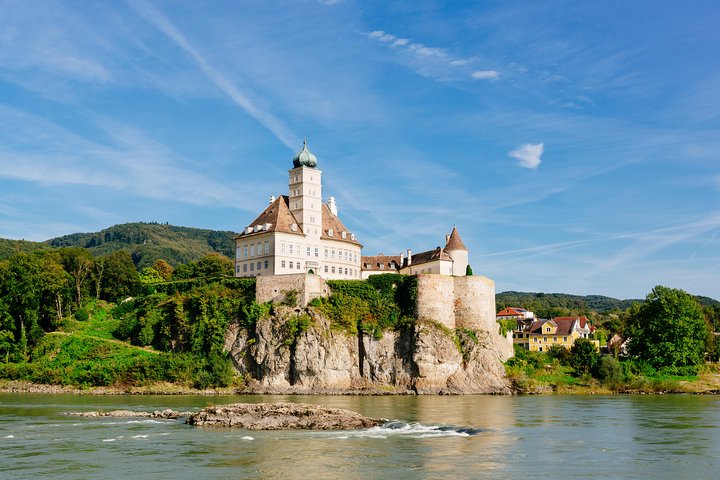
Wachau Valley wine day trips combine wine with landscape, taking you from Vienna to the Wachau — the UNESCO-listed stretch of the Danube valley west of the city where some of Austria’s finest Grüner Veltliner and Riesling are produced. These full-day tours include visits to Wachau wineries, tastings of premium wines, and typically a stop in the medieval towns of Dürnstein or Spitz. The Wachau is covered in more detail on our dedicated page, but for visitors whose primary interest is wine rather than scenery, this is where Austria’s most critically acclaimed wines are made.
Key Austrian Wines to Know
A wine tour guide will walk you through these, but arriving with basic familiarity enhances the experience.
Grüner Veltliner is Austria’s signature grape — a white wine that ranges from light and peppery (the everyday Heuriger style) to rich, complex, and age-worthy (the premium Wachau expressions). It pairs brilliantly with the Viennese cold buffet — the white pepper character cuts through cured meats and cheese.
Gemischter Satz is uniquely Viennese — a field blend where multiple grape varieties are planted, grown, and harvested together in the same vineyard, then fermented as a single wine. The result is more complex and unpredictable than a single-variety wine, and every producer’s version tastes different. Vienna received its own protected wine designation (Wiener Gemischter Satz DAC) specifically for this style.
Riesling in Austria tends toward the dry, mineral, and age-worthy style — more Alsatian than German in character. The best come from the Wachau’s steep terraced vineyards, but Vienna’s hillside Rieslings can be excellent in their own right.
Zweigelt is Austria’s most planted red grape — medium-bodied, cherry-fruited, and approachable. It’s the red you’ll most often encounter at Heurigen and the one that pairs best with the heartier buffet options.
Practical Tips
Don’t drive. Vienna’s public transport reaches the wine villages efficiently (tram line D to Nussdorf, bus 38A to Grinzing, tram 31 to Stammersdorf), and you’ll be drinking. Organised tours handle transport for you. If you’re going independently, use the U-Bahn, tram, or bus and enjoy the ride as part of the experience.
Eat the buffet. The Heuriger cold buffet is part of the experience, not a sideshow. Bread spreads (Liptauer — a paprika-spiced cheese spread, and Grammelschmalz — pork dripping), cold cuts, pickled vegetables, and warm seasonal dishes are designed to accompany the wine. Skipping the food means missing half the tradition.
Start earlier than you think. Heurigen open in the afternoon (typically 3:00 or 4:00 PM) and fill up by early evening, especially on warm weekend nights. Arriving at 4:00–5:00 PM secures a good garden table and lets you experience the atmosphere build as the evening progresses.
Bring a jacket for garden seating. Even on warm summer days, Heurigen gardens in the hillside villages cool down as evening falls. A light layer prevents the choice between discomfort and moving inside, where you lose the garden atmosphere.
Cash is useful at traditional Heurigen. Smaller, family-run establishments may not accept cards, particularly for individual glasses of wine. Bring euros to be safe.
Don’t judge Austrian wine by Heuriger wine alone. The young, fresh Heuriger wines are designed for easy drinking in a social setting — they’re not Austria’s best wines, any more than a pub beer is a country’s best brew. If the Heuriger experience makes you curious, follow up with a structured tasting or a Wachau visit to see what Austrian wine is capable of at its peak.
Frequently Asked Questions
When is the best time for a Vienna wine tour?
Late spring through early autumn (May–October) is ideal. Heurigen gardens are at their best in warm weather, the vines are in leaf or approaching harvest, and the long evenings suit the outdoor tavern culture. The Sturm season (late September–October), when partially fermented new wine is served, is particularly atmospheric. Winter Heurigen visits are possible but the experience shifts indoors.
Can I visit a Heuriger on my own without a tour?
Absolutely. Take a tram to Nussdorf, Grinzing, or Stammersdorf, look for the pine branch (Buschen) indicating an open Heuriger, and walk in. The experience is straightforward — order wine at the counter, fill a plate at the buffet, find a seat. A tour adds cultural context, steers you to the best establishments, and removes the navigation, but independent Heuriger visits are one of Vienna’s great simple pleasures.
How much wine is involved in a wine tour?
Guided tours typically include 3–6 tastings across one or two venues — enough to explore the main styles without excess. At a Heuriger, wine is ordered by the glass or Viertel (quarter litre, roughly two glasses). Pace yourself — the relaxed atmosphere encourages lingering and refilling, and the fresh, easy-drinking style can be deceptive in its alcohol content.
Is the Gemischter Satz really only from Vienna?
Gemischter Satz as a style exists elsewhere in Austria, but the Wiener Gemischter Satz DAC designation — guaranteeing a specific quality level and Viennese origin — is exclusive to Vienna’s vineyards. The city’s unique urban terroir and the tradition of field-blending give Viennese Gemischter Satz a character distinct from versions produced elsewhere.
Are wine tours suitable for non-drinkers?
The Heuriger experience is primarily about the atmosphere, setting, and food tradition alongside the wine. Non-drinkers can enjoy the garden ambiance, the cold buffet, the vineyard views, and the cultural context. Most Heurigen serve grape juice, soft drinks, and Sturm (the non-alcoholic early stage is called Most) as alternatives. A wine-focused tasting session would be less rewarding for a non-drinker, but a Heuriger evening works regardless.